



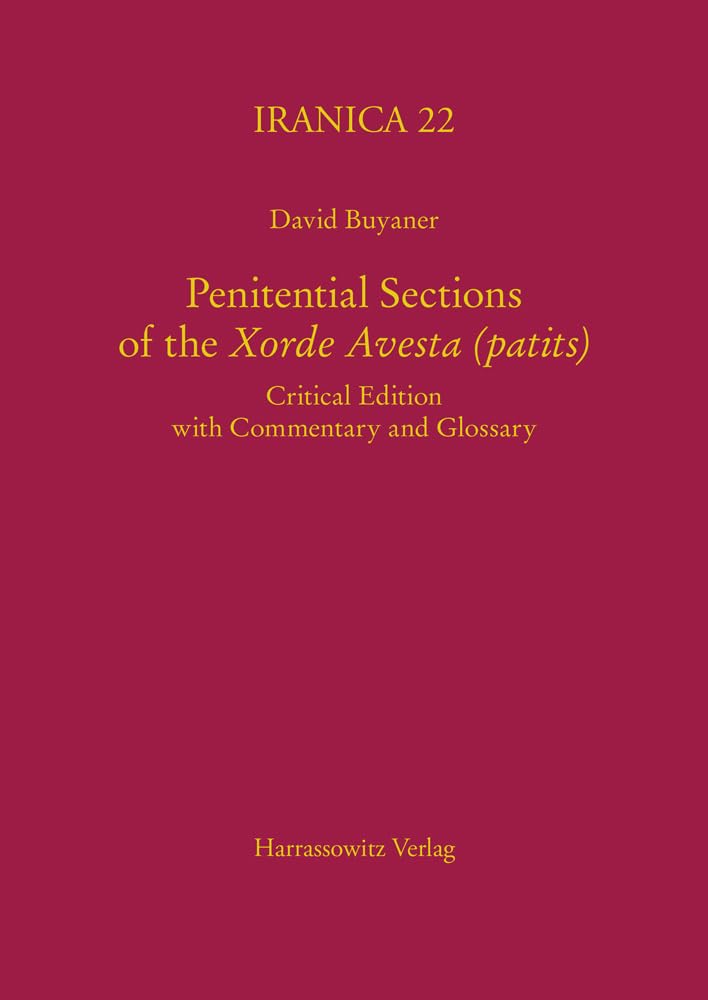
Penitential Sections of the Xorde Avesta (patits): Critical Edition with Commentary and Glossary (Iranica)

 4.3 (51 items)
 Limited Time Sale
$69.58 cheaper than the new price!!
Free cash-on-delivery fees for purchases over $99
Product details
| Management number | 233526949 | Release Date | 2026/06/27 | List Price | $46.39 | Model Number | 233526949 | ||
|---|---|---|---|---|---|---|---|---|---|
| Category | |||||||||
The Zand i Xorde Awesta, the Pahlavi version of the compilation of Avestan liturgical texts with the traditional name ""Small Avesta"" (Xorde Awesta), is one of the main monuments of the corpus of Pahlavi translations and commentaries (called zand) of Avestan original texts. Since the Xorde Awesta and its Pahlavi version consist of a variety of heterogeneous texts which belong to different strata of Zoroastrian literature, they are not only sources of utmost importance for Avestan and Pahlavi philology, but also for the history of Zoroastrianism, and, especially in its penitential sections, for the reconstruction of Zoroastrian law. The recitals of repentance called Paded i pasemanih (""Penitentiary prayer for repentance"", in two versions) and Xwad paded (""Penitentiary prayer for oneself""), which are the main focus of this project, are of great interest for the reconstruction of Zoroastrian jurisprudence, since they contain the most extensive enumeration of sins and offences, using the specific terminology of religious and criminal law. The semantic and etymological analysis of legal vocabulary is one of the most urgent desiderata of Iranian Studies. Two other significant problems in this context concern the date of the composition of the Xorde Awesta and the underlying principle of its compilation. An exact analysis of those sections of the Zand i Xorde Awesta without a prototype in the Avestan original, such as the Paded texts, which are also known in their Pazand version (i.e. in Middle Persian written in the Avestan script), would shed light on the question as to why these compositions were included in a zand compilation and the problem of the origins of this unique source. Read more
Bestseller ranking
All Harley-Davidson Handlebars


Customers who viewed this product also viewed
General Mills Cereal






Correction of product information
If you notice any omissions or errors in the product information on this page, please use the correction request form below.
Correction Request Form